

Don’t underestimate the power of a good brief
In an industry obsessed with outputs—campaigns, films, headlines, impressions—the creative brief often remains invisible. Yet it is the quiet foundation on which all effective communication stands.
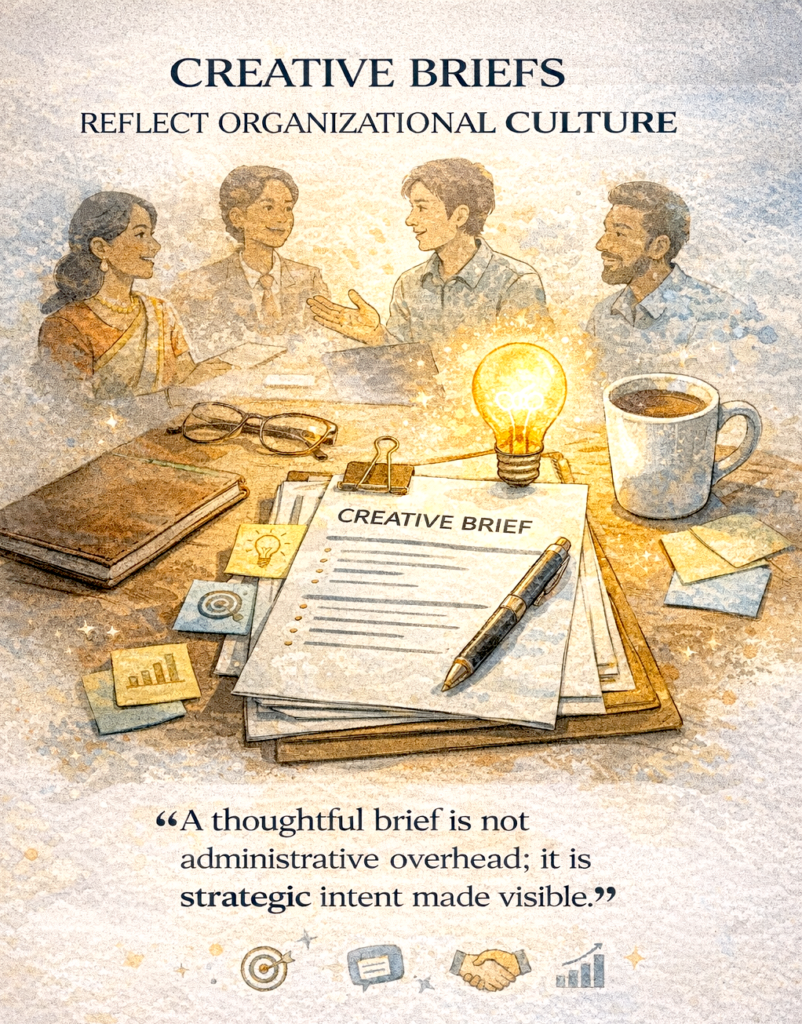
A well-drafted, thoughtfully crafted creative brief is not just a clear statement of the brand owner’s expectations; it is also an agreement on achievable deliverables. It is a focused, strategic document that guides the creative process. It is the beginning of a collaborative journey; when done right, the final product delights all stakeholders—the creators, the brand owners, and the end consumers.
I understood this far earlier than I realised—right after high school, during my very first professional assignment.
My First Lesson: All India Radio
I was sitting across a table from the then Programme Officer at All India Radio (AIR), Mumbai, Shailesh Malode. I was young, eager, and unaware that I was about to receive one of the most important lessons of my professional life.
He explained, with precision, what he expected me to write: a set of four scripts, each five minutes long. He outlined the overarching theme and clearly broke down what each episode needed to address. There was no ambiguity about intent or structure.
Then came the part that truly shaped my understanding of discipline in creativity. He told me the precise timing available within those five minutes. I had to account for the opening roll, the segment announcement, and the closing piece before the next segment would fade in. That left me with exactly four minutes and thirty seconds of actual content. Nothing more. Nothing less.
He also told me who would eventually lend their voice to the script. Much later, I learned that audio scripts are often written at a specific words-per-minute pace, calibrated to a reader’s natural speech pattern. He pointed me to reference materials, explained attribution norms, and even guided me on the authorisation forms required for AIR Mumbai’s archives.
This was my very first creative brief.
At the time, it felt like a lot of information. Yet, perhaps instinctively, I understood the immense significance of a well-crafted creative brief.
A Good Brief Is a Compass, Not a Constraint
Many professionals think briefs are creatively restricting; in reality, the opposite is true. That perception often stems from the widespread sharing of poorly crafted creative briefs in the industry.
A well-crafted creative brief does not box ideas in; it gives them direction. It removes uncertainty, allowing creative energy to be devoted to problem-solving rather than guesswork. It tells you where the boundary is so that creative people can push meaningfully against it.
In my AIR assignment, the brief did not limit my imagination. It helped me focus on executing the final script. Knowing the duration, the audience, the voice, and the format allowed me to write with intent. Every word had a reason to exist. Every second mattered.
This lesson has stayed with me across formats and decades as I draft and help my clients craft creative briefs to ideate and execute projects for radio, brands, NGOs, corporate communications, and campaigns with multiple stakeholders and sensitivities.
What Makes an Effective Creative Brief?
Over the years, across sectors and scales, I have returned to a few core traits that consistently define effective briefs.
Be Focused
What are we really trying to achieve here? That’s the fundamental question a focused brief answers.
Without focus, creativity wanders in all directions and projects expand endlessly. Open-ended discussions lead to new expectations surfacing midway, objectives blurring, and teams losing momentum. A focused brief draws a clear line between what is essential and what is incidental. It protects both the time and creative energy of the project and the professionals involved.
Be Insight-Driven
Good briefs are not built on assumptions; they are anchored in insight.
Who is the audience? What do they care about? What do they already know—or believe—about this subject or brand? Insight-driven briefs ensure that communication is not self-referential but audience-centric.
In my early radio work, the implicit insight was clear: the listener’s attention is precious, fleeting, and intimate. That understanding shaped how stories were structured and paced.
Be Actionable
A brief should eliminate confusion, not create it.
“Create something impactful” or “write an attractive copy” are not briefs. Actionable briefs clearly define deliverables, formats, timelines, and success markers. They enable teams to move from thinking to doing without constant clarification. The devil is in the broader details, not in micromanagement.
The clarity I received at AIR—five minutes, four episodes, defined segments—left no room for ambiguity. It empowered execution.
Be Aligned
One of the most common failures in creative communication projects is misalignment.
A campaign may look good creatively but fail strategically because it doesn’t reflect the brand’s larger goals, values, or positioning. A strong brief ensures that creativity serves both the immediate objective and the long-term brand narrative.
Alignment is what transforms isolated campaigns into coherent communication systems.
Be Collaborative
A creative brief is not a one-way instruction manual. It is a collaborative yet exhaustive document.
The most effective briefs emerge when clients, strategists, and creative teams work together to shape the problem and build a vision for the solutions. This shared ownership reduces friction later and builds trust early in the process.
That early AIR experience taught me something subtle but powerful: briefing is not about authority; it is about clarity and respect for the creative process.
Why Poor Briefs Cost More Than Time
I am no stranger to bad briefs. I have also dealt with brand identities born from poorly drafted briefs and a development process that went sideways.
In one client project, I discussed website requirements in detail. I understood their needs and design inspirations and did my best to capture and document their vision. I translated it into a meticulously drafted creative brief. After the client reviewed and refined it, we locked it in and forwarded it to the developers.
What I failed to anticipate led to repeated revisions, suboptimal output, and a client perception of the process as “perfect-as-you-go.” The resultant website had all the features and design elements, but the way it was packaged to remain fully visible on-screen at all times meant the content was barely legible across all screen sizes.
The lesson for me was clear: walk the client through the development process, and set and enforce clear boundaries. More importantly, educate the client on how websites and online assets work, using live examples, so they are comfortable with different creative decisions before development begins.
I am convinced that poorly written briefs often lead to repeated revisions, misaligned expectations, frustrated teams, and diluted outcomes. More critically, such assets erode trust. When briefs are vague or constantly shifting, creative teams stop taking risks. They play it safe. Innovation suffers.
I encountered one such flawed brand identity in my first professional assignment as a corporate communications professional. The recently refreshed identity used text to anchor it in the organisation’s rich legacy. The issue: the text was so small that it often appeared as two black lines in smaller logo reproductions.
After taking charge of the organisation, I approached the creative agency that had developed the brand identity. I showed them my print samples, clearly highlighting the issue. Liaising between leadership, internal stakeholders, printers, and the agency, we tested a few fonts that appeared clearer at smaller point sizes—in black and in reverse. Then we finalised the one that best aligned with the rest of the identity and the overall brand guidelines.
In another example, a multi-layered identity had overlapping, transparent elements that appeared muted and muddled on websites and in print. They looked great on high-resolution screens, but never in web palettes and CMYK.
The issue and the solution were deceptively simple. The transparency settings were set only 10 points apart, making web and print rendering difficult. After multiple tests, we arrived at a 25-point difference. The revised identity wasn’t as ‘light’ as before, but it reproduced consistently and vibrantly across media—on-screen and in print.
Beyond Process: Briefs are Cultural Documents
Over the years, I have come to view creative briefs as cultural documents. They are more than project or process checklists.
They reflect the organisational culture of respect—or the lack of it. Creative briefs signal respect for time, for expertise, and for collaboration. They indicate that communication is valued as a strategic function, not an afterthought. In contrast, chaotic briefs often mirror deeper organisational indecision.
Whether you are a brand owner, a communications professional, or a creative practitioner, investing time in a thoughtful brief is not administrative overhead; it is strategic intent made visible and brand reputation encoded into a document. As communications professionals, we must remain aware of the brand reputation reflected in our creative briefs.
Looking back, I realise how fortunate I was to learn this lesson early, before buzzwords, before decks, before deadlines multiplied. That first creative brief at All India Radio taught me that clarity is not the enemy of creativity; it is its strongest ally.
Every successful collaboration begins not with an idea, but with a shared understanding of what is possible. And that understanding, almost always, begins with a well-crafted creative brief.
What makes an effective creative brief for you?
This article has research contributions from an AI platform (ChatGPT) to the tune of ~25%.