
From Volunteer to Communicator: Lessons Beyond the Office
Volunteering, in my experience, is more about learning and gaining than about giving back and social responsibility. Volunteering has profoundly shaped me as a communications professional. Want to know how? Read on.
For a successful career as a communications professional, one must master a few things. A few of them are: clear, credible storytelling; strategic thinking with situational judgement and discretion; stakeholder empathy and intently listening to them; and crisis readiness with emotional control in such situations. Interestingly, I acquired these skills as an environmental volunteer and educator. Even today, I hone these skills by volunteering from time to time.
In popular discourse, volunteering is often portrayed as an opportunity to serve, give back, or exercise social responsibility. For me, volunteering is an intense, ongoing education, or as the modern LNOD professionals like to call it, continuous education. It has quietly shaped and reshaped how I observe, respond, and relate to the world. Its lessons are rarely delivered through instruction; they emerge through encounters, silences, unexpected questions, and moments of shared humanity.
Learning Across Generations
One of the most striking experiences volunteering has given me is interacting with children, college students, working professionals, and older adults in a single day. These encounters, though vastly different in energy and rhythm, are united by a powerful reminder: every audience teaches you how to communicate better.
With children, creativity becomes instinctive. Their openness, curiosity, and imagination demand that you abandon rigid structures and respond with playfulness and spontaneity. Creativity, I have learned, is contagious. When children engage freely, it pushes you to think visually, narratively, and emotionally. I was challenged to improvise explanations or activities on the spot. This taught me to think on my feet, out of the box, adapt language quickly, and let ideas evolve in situ.
Children often responded in unique ways. While their parents worried and asked us whether we wouldn’t encounter a leopard on a forest trail, more often than not, the young minds were most excited about the fact that the forest had leopards. And the possibility of encountering them in the wild. Or in Kerala, while I volunteered to photograph sessions with schoolchildren, we all feared that the children would go silent when they saw the camera and a new person in the classroom, other than their usual educator. However, we were surprised by their enthusiasm in the class, including the involvement of those who were usually quiet, whenever I visited the classrooms. The very presence of a camera and a professional photograph excited the GenZ students.
In contrast, conversations with older people cultivate patience and attentiveness. I always find their pace calming, and their stories layered with more profound reflections. Volunteering with them reinforces the value of evolving communications—not just broadcasting but also listening, absorbing, processing, and responding.
Moving across these different kinds of audiences in a single day has sharpened my communication skills in a way no training workshop can. I have learned the significance of tone, pace, intent, storytelling, language, and such details to ensure effective engagement with the audience.
The Quiet Power of “I Don’t Know”
As communications professionals, we are constantly under pressure to feed information, share stories, stay up to date with trends, and respond to queries instantly. Most of my fellow professionals fear ‘not knowing’ when asked to respond. However, that was precisely the first lesson I learned from my trainer, Dr V. Shubhalaxmi Reddy, at the Conservation Education Centre of the Bombay Natural History Society.
It is one of the most liberating lessons of my life, and volunteering has taught me the power of admitting uncertainty. In corporate and PR environments where crossing and probing the communications professionals is a norm, it is often tempting to provide quick answers. Yet saying “I don’t know” or “Let me get back to you after verifying information” can be far more meaningful.
This simple admission removes the pressure of having to perform expertise and replaces it with openness. Often, questions raised during volunteering—about nature, society, or lived experiences—do not have straightforward answers. Acknowledging this uncertainty creates space for shared exploration.
While working as a communications professional, facing journalists and internal stakeholders, saying “I don’t know” often sparked deeper engagement. It invited dialogue rather than closure. Many times, a question became the starting point for revisiting assumptions and collaborating with internal and external stakeholders.
Importantly, it offers me the freedom to be an ‘insider’ for external stakeholders while learning alongside internal stakeholders, positioning myself as a ‘collaborator’ rather than an ‘extractor’ of information. Volunteering environments thrive on this mutual learning, where curiosity becomes the common ground and offers a safe space for young, aspiring communications professionals.
Sustainability-Focus Sharpens the Senses
Volunteering in sustainability and conservation contexts has had a profound effect on how I function as a communications professional.
First, it has trained me for attention to detail. Whether observing ecosystems, waste patterns, or everyday resource use, sustainability-focused volunteering encourages careful observation. I began to notice small shifts: movements, sounds, changes in local weather patterns, soil textures, bird behaviour, and human interactions with landscapes. This attentiveness extends beyond the field into professional life.
Second, it has taught me the value of long-term commitment. Sustainability work often emphasises long timelines and incremental change. Progress is not always dramatic or immediate. Instead, satisfaction comes from modest successes and consistent efforts. PR and communications may have their moments of acute delivery in product launches and emergency communications; however, the brand or the communicator’s perceptions are shaped by consistent, committed, long-term engagements.
Finally, sustainability-focused volunteering fosters a deep sense of connection. It has connected me to places, to people, and to the causes far more significant than any one individual, including myself. There is a quiet grounding that comes from poignant acts and moments, such as touching soil, walking through neighbourhoods, and listening to lived experiences. This sense of connection through messaging, brand, and, ultimately, the consumer of my stories has created a lasting bond over the years with stakeholders, both internal and external.
Volunteering, I have learned, is not an act separate from life. It is neither a mere project to boost my CV. It is a way of engaging with people. It is an impactful way of continuous learning. It is a perfect workshop for a creative communications professional.
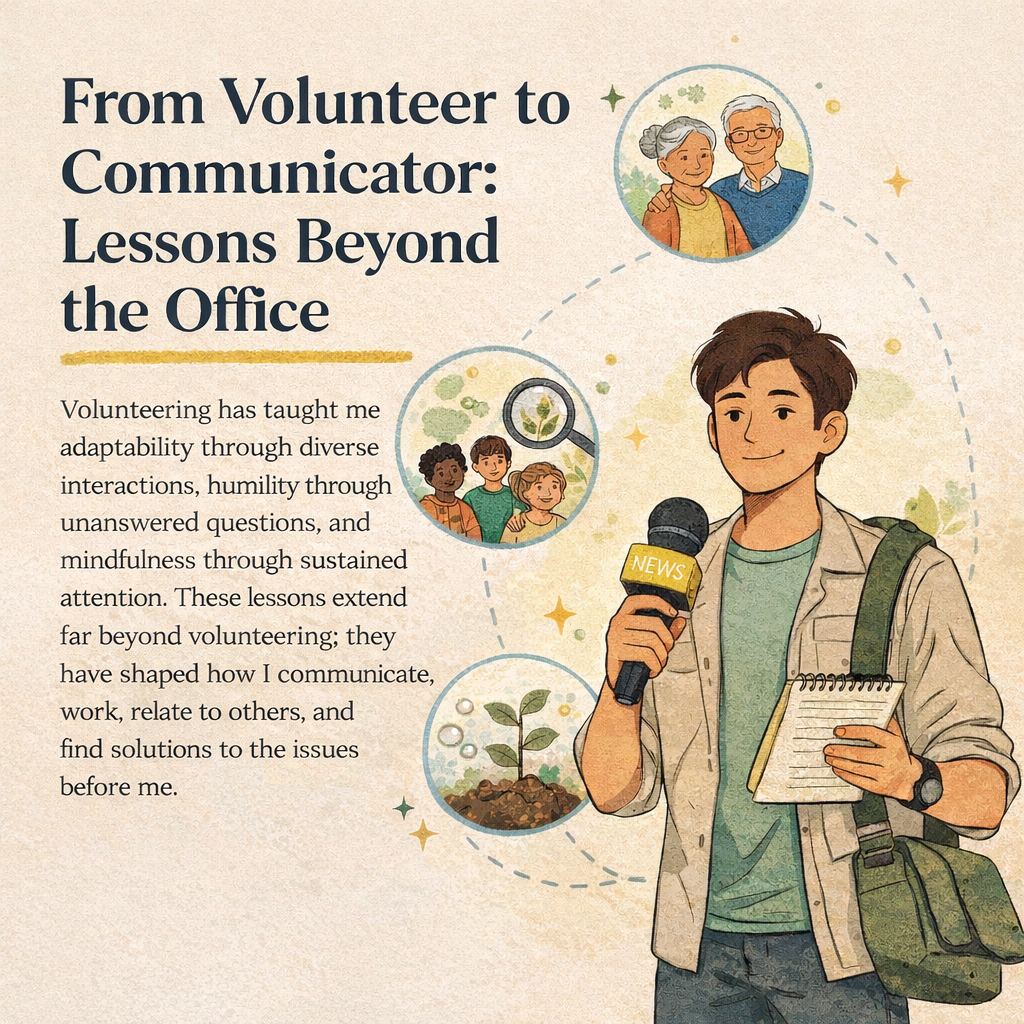
Volunteering has taught me adaptability through diverse interactions, humility through unanswered questions, and mindfulness through sustained attention. These lessons extend far beyond volunteering; they have shaped how I communicate, work, relate to others, and find solutions to the issues before me.
In a world increasingly driven by high-pitch communications, the overload of information with no time to process or make sense of it, volunteering offers a counterbalance. It encourages one to slow down. It pushes one to pause before acting. It reminds us to go back to basics: listening, observing, and being present.