
India’s Export Growth in a Protectionist Era
This special feature examines how India’s exporters — MSMEs, in particular — can navigate US tariffs, the challenges of protectionism, and create growth opportunities by leveraging new opportunities and achieving success through data-driven decision-making.
As one of the world’s largest economies, India plays a pivotal role in global trade. This role is critical for the nation’s economic growth and reshaping global trade dynamics. The significance of India’s exports extends beyond financial transactions; it underscores the ability to enhance its competitive edge, encourage innovation, and create employment opportunities.
India has proven its mettle in a broad range of industries and sectors — from pharmaceuticals, textiles and garments, engineering, automobiles, printing and packaging services, machine manufacturing, and agricultural products. Moreover, it dominates the information technology-driven services sector. With such diversity, India’s economy has proven resilience against international trade shocks by placing itself firmly in diverse global supply chains. Moreover, it adds a unique leverage against growing protectionist sentiments in major economies worldwide.
According to the Ministry of Commerce and Industry, Government of India, in FY 2022–2023, India’s total exports (goods and services) reached a record US$776 billion, of which merchandise exports stood at US$451 billion and services exports at US$325 billion.
The Tantrum Tariffs: Challenges and Opportunities
The US tariffs, particularly their arbitrariness and volatility, along with uncertain macroeconomic conditions in leading international markets, present both challenges and opportunities for Indian exporters. In particular, the penalising import duties pose significant barriers to the competitiveness of Indian products in the US. The situation is particularly challenging for Micro, Small and Medium Enterprise (MSME) exporters, who often lack the resources to absorb the additional costs needed to adapt to such high volatility in export markets.
As these enterprises strive to navigate the intricacies of global trade, it becomes imperative to understand how tariff negotiations can affect their operational viability. However, despite the initial shock of increased market access barriers, MSME exporters from India seize the opportunity to double down on innovation and diversification, reevaluate their supply chains, and explore new market opportunities. Challenging times can turn into opportunities for growth and profitability.
India’s Export Champions, the MSME Businesses
India’s export growth is ably supported by the country’s MSME sector, which contributes substantially to national GDP and international trade. These businesses are a crucial part of the domestic industrial landscape and supply chain. In fact, MSME exporters contribute about half of (48%) of the country’s overall export value according to the Ministry of MSME, Government of India, statistics published in 2023. It underscores the critical role MSME exporters play in the country’s foreign trade.
Additionally, these small businesses are the backbone of employment generation and innovation in the country. Together, ~63 million MSMEs employ about 100 million people.
However, despite their significant impact on export performance, MSME exporters face numerous challenges that hinder their growth potential in international markets. Issues such as limited access to finance, growing yet inadequate infrastructure, and lack of awareness of global market trends pose considerable barriers.
Policymakers must address the issues faced by MSME exporters to boost their contributions to the economy and trade. To harness the full potential of the MSME sector, governments should invest more in targeted support to meet the unique needs of MSME exporters and drive growth in domestic and export trade.
Exploring new markets for India’s Exporters
Expanding into new export markets has become critically important for India’s exporters aiming to protect their export revenue and broaden their global presence amid current volatility. They need to look beyond traditional markets, such as the US and Europe. Several developing economies across different continents, especially in Africa, present dynamic opportunities. These nations are characterised by rapid growth and an exponentially increasing demand for products and services. The potential of these emerging markets offers promise for India’s export growth, fostering optimism.
Emerging economies in Africa, Southeast Asia, and Latin America are gaining significant importance among India’s exporters as a means of achieving growth. According to EXIM Bank of India (2023), ‘Africa–India trade reached US$95.5 billion in FY 2022,’ while the ASEAN Secretariat reported in 2023 that the ‘ASEAN–India trade crossed US$131 billion in 2022.
Indian exporters need to allocate resources for thorough market research to access these new markets effectively. They should understand the distinct customer preferences and regulations in these markets. Moreover, they must assess the competitive landscape and potential barriers to entry, and develop corresponding mitigation strategies. Conducting research and relying on data-driven decisions will be crucial for fostering sustainable export growth and enhancing India’s position in global trade.
A 2021 NITI Aayog report notes that “Exporters leveraging platforms such as the Export Preparedness Index” and UN Comtrade data can make informed decisions. AI-driven trade platforms help forecast demand shifts, and benchmarking tools allow exporters to evaluate competitiveness. Embracing such technological platforms will not only improve operational efficiency but also position companies favourably within the ever-evolving landscape of international trade.
New Export Opportunities in a Post-Pandemic World
India’s businesses are capitalising on their investments to identify and capture new export opportunities in the post-pandemic global trade landscape. The increasingly protectionist, less liberalised economies worldwide present challenges for international trade; however, at the same time, many emerging economies are capitalising on their markets both ways. They attract more imports of products and services as their consumption increases, while contributing to global trade through exports. On the one hand, it has created competition for India’s products and services; on the other hand, with its long experience in information technology and the digital revolution, India’s businesses are better equipped to offer value-added, high-quality, competitively priced products and services for different import-oriented markets. Thus, by carving out a niche and staying agile, Indian businesses can capitalise on the tremendous opportunities that global trade still offers, despite growing competition and uncertainties.
In FY 2022, India’s services exports grew by 27%, reaching US$325 billion (NASSCOM, 2023). Merchandise exports such as pharmaceuticals and engineering goods gained importance due to global supply chain diversification.
The EU’s Green Deal creates avenues for eco-friendly products such as organic textiles, responsibly sourced paper and paperboard products, and sustainable agriculture.
The key to expanding India’s presence in global trade is for Indian businesses and policymakers to push the boundaries of innovation, quality, and efficiency. Fostering strategic alliances and partnerships with local distributors in emerging markets is another effective way to facilitate smoother entry into new markets.
Policy-linked bottlenecks and positive push
Export bottlenecks due to government policies in India largely stem from three issues: High trade costs (logistics, compliance, taxes); Policy unpredictability (export bans, incentive changes); and Limited structural support (finance, standards, GVC participation).
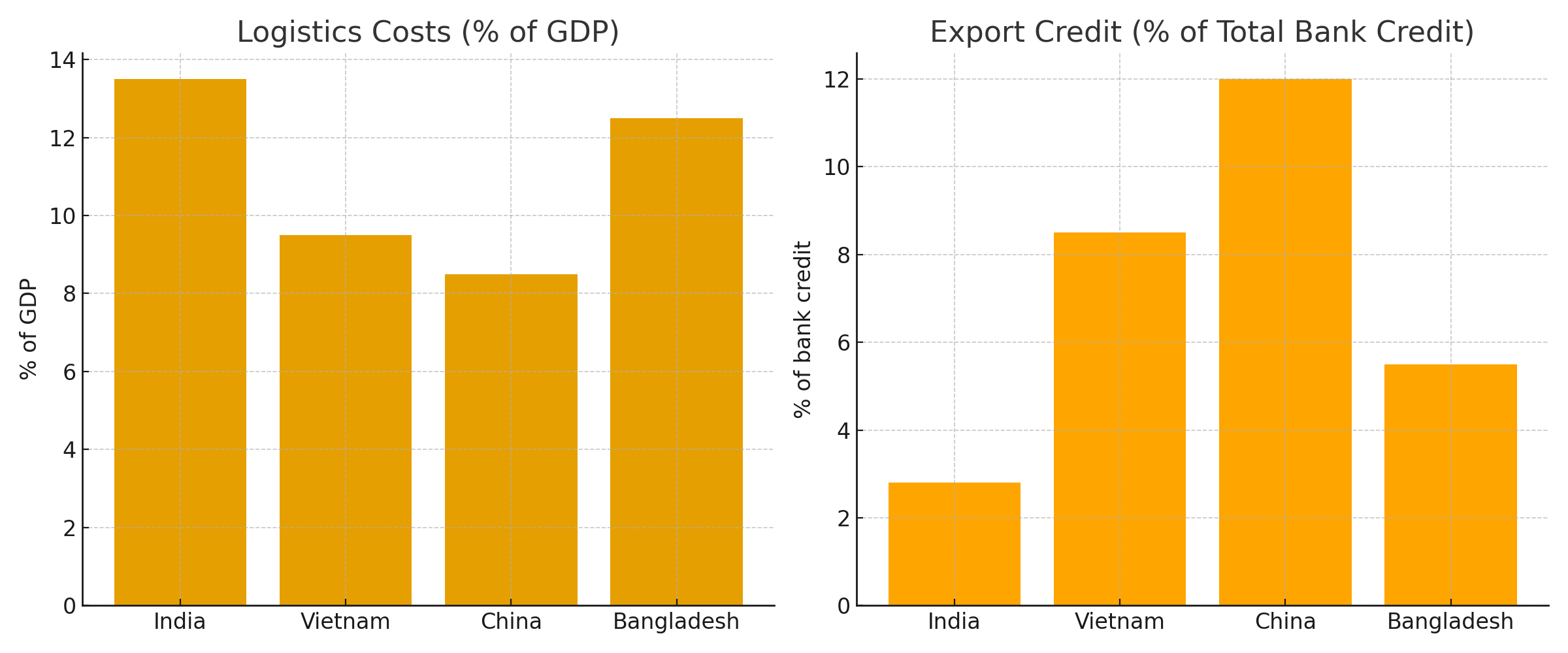
According to a 2023 World Bank report, ‘Connecting to Compete’, logistics costs in India account for ~13–14% of the country’s GDP, compared to 8–9% in developed economies. Port congestion, inadequate last-mile connectivity, and over-dependence on road over rail and waterways increase costs. However, the report also highlights the government-led interventions: “Since 2015, the government of India has invested in trade-related soft and hard infrastructure connecting port gateways on both coasts to the economic poles in the hinterland.” With the government’s focus on enhancing infrastructure capabilities, India’s exports are poised for substantial growth, alleviating logistics-related pain points.
Complex taxation and incentivising schemes, such as the Remission of Duties and Taxes on Export Products (RoDTEP) and the Service Exports from India Scheme (SEIS), often face delays in refunds and revisions to rates. Governments — Union and State — must work in sync while promoting digitisation, enhancing efficiency, and simplifying processes to enable faster clearances and reduced compliance burdens for exporters, especially smaller businesses. Frequent and unpredictable policy changes are creating unnecessary setbacks and challenges for India’s exporters. For example, a sudden withdrawal of export incentives (such as MEIS in 2020) and overlapping union- and state-level taxes on inputs create policy ambiguity, uncertainty, and increased costs for exporters. Moreover, overnight export bans or restrictions on agricultural items, such as rice, wheat, sugar, and onions, undermine India’s reliability as a supplier.
Access to affordable and competitive finance is a critical requirement for profitable exports from India. A 2022 OECD report highlighted that ‘export credit is just 2.8% of total bank credit in India, compared to 12% in South Korea. High interest rates on export finance reduce the competitiveness of domestic exporters, while placing additional pressure on MSMEs and small export houses due to limited collateral and a lack of awareness about different government schemes. Various Export Promotion Councils in India work to support exporters and businesses across multiple sectors and trades, creating access through market linkages, enhancing awareness among member exporters, and promoting Indian suppliers at global platforms, including trade shows and bilateral negotiations.
Union and state governments in India offer a range of schemes to enhance businesses’ awareness and compliance with regulations, including those related to the US FDA, EU REACH, and sustainability certifications, among others, to facilitate successful exports to various foreign markets. Gradually, but with increasing momentum, governments are promoting investments in laboratories, driving quality certifications, and encouraging investments in sustainable, eco-friendly technologies.
Sustained Profitable Growth for Indian Exporters
India’s diverse and dynamic export sector plays a crucial role in driving the national economy, fostering innovation, and generating employment opportunities. Currently, it faces challenges such as US tariffs, high logistics costs, and unpredictable policies, particularly affecting MSMEs, which account for nearly half of India’s exports. However, new growth opportunities are opening up in Africa, Southeast Asia, and Latin America. Indian exporters must, in addition, undertake thorough market research and employ data-driven approaches to succeed in global trade by understanding global trends and maintaining competitiveness. Policy changes that enhance infrastructure, lower trade costs, streamline export incentives, and provide affordable financing will hopefully ensure steady and profitable growth.
References
- ASEAN Secretariat. (2023). ASEAN–India trade statistics.
- Export-Import Bank of India (EXIM Bank). (2023). India–Africa Trade and Investment.
- Ministry of Commerce & Industry. (2023). India’s Export Data FY 2022–23. Government of India.
- Ministry of MSME. (2023). Annual Report 2022–23. Government of India.
- NASSCOM. (2023). Indian IT–BPM Industry Report.
- NITI Aayog. (2021). Export Preparedness Index.
- OECD (2022), OECD Economic Surveys: Korea 2022, OECD Publishing, Paris, https://doi.org/10.1787/20bf3d6e-en.
This article has resaerch contributions from an AI platform (ChatGPT) to the tune of ~30%.